.svg)
.svg)
.svg)
.svg)
.svg)





.avif)


.svg)
.svg)
.svg)


Enterprise Software Creates Value With Abstraction


Understanding the layers between a language model and a product you can rely on
Large language Models have become incredibly powerful. They can reason through complex problems, generate human-quality text, and understand nuanced questions. That's transformed what's possible with software.
But foundation models are just one piece of the puzzle. The gap between a capable LLM and a product that works reliably in your business is wider than it looks.
Every Category-Defining Product "Wraps" Something
There's a common critique that AI products are just wrappers around foundation models. It's worth examining what that actually means.
Veeva built a multi-billion dollar business on top of Salesforce. Salesforce itself is built on AWS and other cloud infrastructure. Cursor and Perplexity have reached multi-billion dollar valuations building on top of LLMs.
This is how software has always worked. Value comes from what you build on top of foundational technology, not from rebuilding the foundation itself. The question isn't whether you use underlying infrastructure but rather what you create with it.
Defensibility Lives in Domain-Specific Systems Engineering
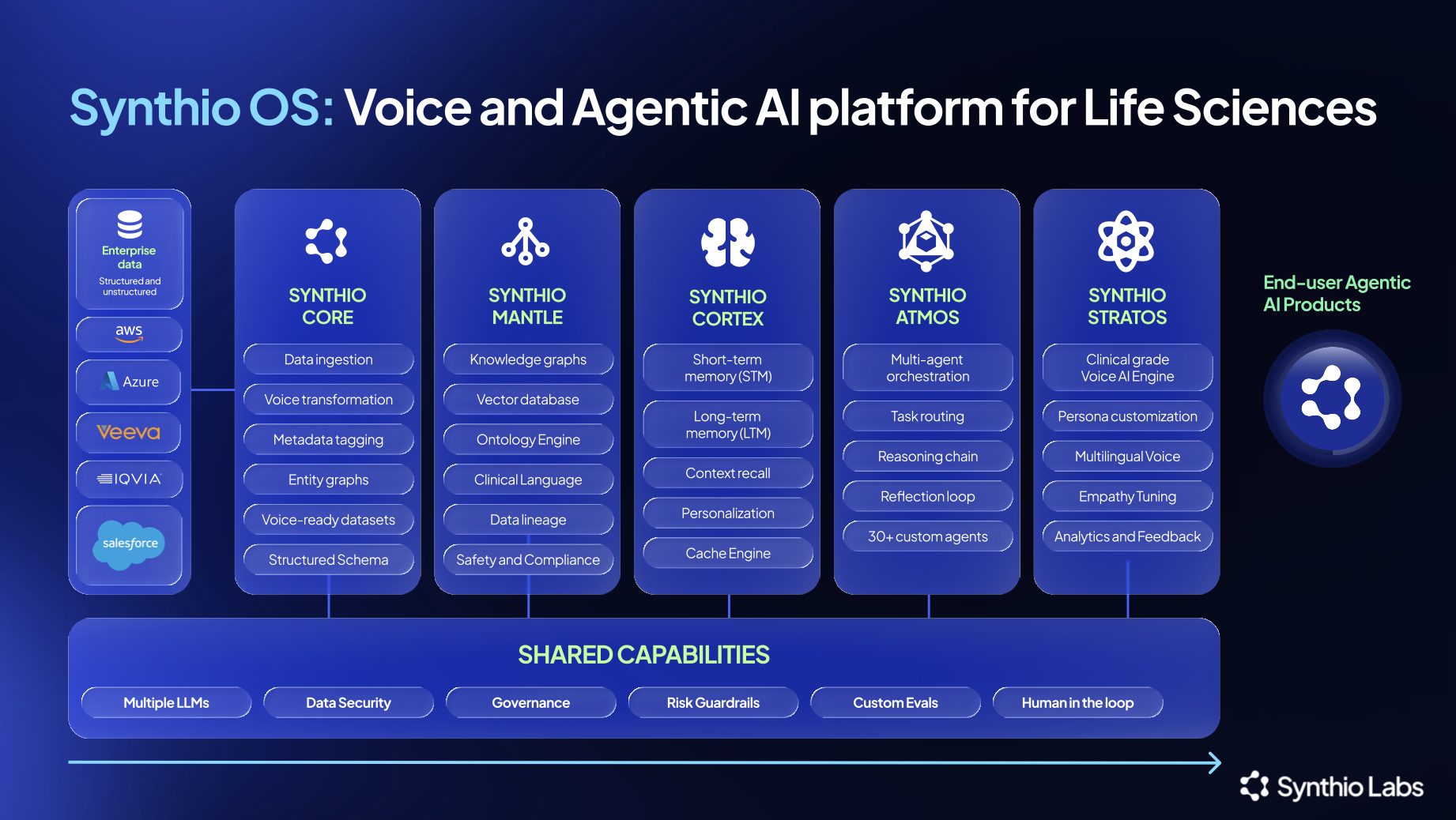
Our experience deploying multimodal AI systems across large pharma has made one thing clear, that differentiation emerges at the systems layer where domain semantics are encoded into data schemas, stateful workflows, policy engines, and deterministic edge-case handling.
Here's how we think about the layers that turn a model into a platform.
Orchestrating Intelligent Workflows
Language models excel at reasoning, but business applications require action. When a user asks a question, the system needs to decide which data sources to query and how to synthesize everything into a coherent response.
We've built an orchestration layer that maintains rich conversation context across multiple turns and sessions and executes complex operations in a single interaction.
When a field rep asks "What should I discuss with Dr. Smith at today's meeting?", the system pulls recent interactions, checks prescription trends, reviews relevant clinical studies, and synthesizes a briefing in milli-seconds. The underlying system handles reasoning and our orchestration determines what to reason about and ensures actions happen in the right sequence.
Grounded in Your Enterprise Data
Generic AI draws from training data that's months or years old. For business applications, that's not good enough.
Our platform treats your data as the source of truth. We continuously ingest from your existing systems — CRM, marketing automation, medical affairs databases, compliance records — and maintain a unified knowledge graph that understands the relationships between HCPs, accounts, products, and interactions. When a user asks about an account, they get information pulled from live data.
This is why our AI doesn't hallucinate physician names or invent prescription numbers. Every factual claim is traceable to a source system. If the data isn't available, the system says so rather than making something up. In regulated industries like pharma, this grounding is required.
Data Structure Matters
AI agents are only as good as the data they can access and how that data is structured.
Raw data dumps don't work. When an agent needs to answer "Who are my highest-priority HCPs this week?", it needs data organized to make that question answerable with clear field names, consistent formats, and logical relationships between entities.
We've built domain-specific ontologies for life sciences. Our preprocessing pipelines understand that "Dr. John Smith, Oncologist at Memorial Hospital" and "J. Smith, MD - Memorial Onc." are the same person. We normalize specialties, resolve facility names, link prescribing data to the right physicians, and structure everything so agents can query reliably. We maintain entities for HCPs, accounts, products, and territories with relationships that mirror how your business actually works.
The difference between an agent that confidently gives wrong answers and one that provides accurate, actionable information comes down to how well the underlying data is prepared. We do this work so your teams don't have to.
Guardrails, Evals, and Continuous Monitoring
Our guardrails are domain-aware. The system knows what constitutes promotional content, what claims require medical-legal review, and when to route questions to compliance. They're built specifically for life sciences workflows and can be customized to your company's policies.
We run continuous evaluations that measure factual accuracy against source systems, appropriate use of medical terminology, compliance with regulatory requirements, and whether the AI correctly used available tools and data. They run both in development and in production.
Our monitoring goes beyond error tracking. We measure response quality by therapeutic area, tool usage patterns by user segment, and track whether agents are improving outcomes for field teams. When something drifts — response times slow down, accuracy drops in a particular domain, a data integration breaks — we catch it before your users do.
Voice-First Design
Adding voice to a chat interface is straightforward. Building voice-first is a different challenge entirely.
We built our platform with voice as a primary interface from day one. Our system handles natural turn-taking, interrupts gracefully when users change direction mid-sentence, and uses domain-aware transcription that correctly recognizes drug names, medical terminology, and physician names.
What makes this work is that our voice and text agents share the same underlying infrastructure — the same tools, the same data access, the same evaluation framework, the same observability.
A conversation can start in voice during a drive, continue in text while walking into a meeting, and resume in voice on the way home. Context flows seamlessly across modalities.
This interoperability is essential for field teams who need AI that works however they're working.
Enterprise-Grade Infrastructure
Behind any production AI product is serious infrastructure, everything from secure compute, persistent storage, search capabilities, and async processing, to compliance controls.
We've built infrastructure that meets enterprise requirements (e.g., SOC 2 compliance, role-based access controls, audit logging for every interaction, data residency controls, the ability to deploy in your VPC when needed). Our systems handle thousands of concurrent voice sessions while maintaining sub-second response times.
We’ve built our stack to be portable. As capabilities evolve across cloud providers, we can adopt them without disrupting end users. You get the best available technology at each layer without being dependent on any single vendor's roadmap.
Great Products Abstract Complexity
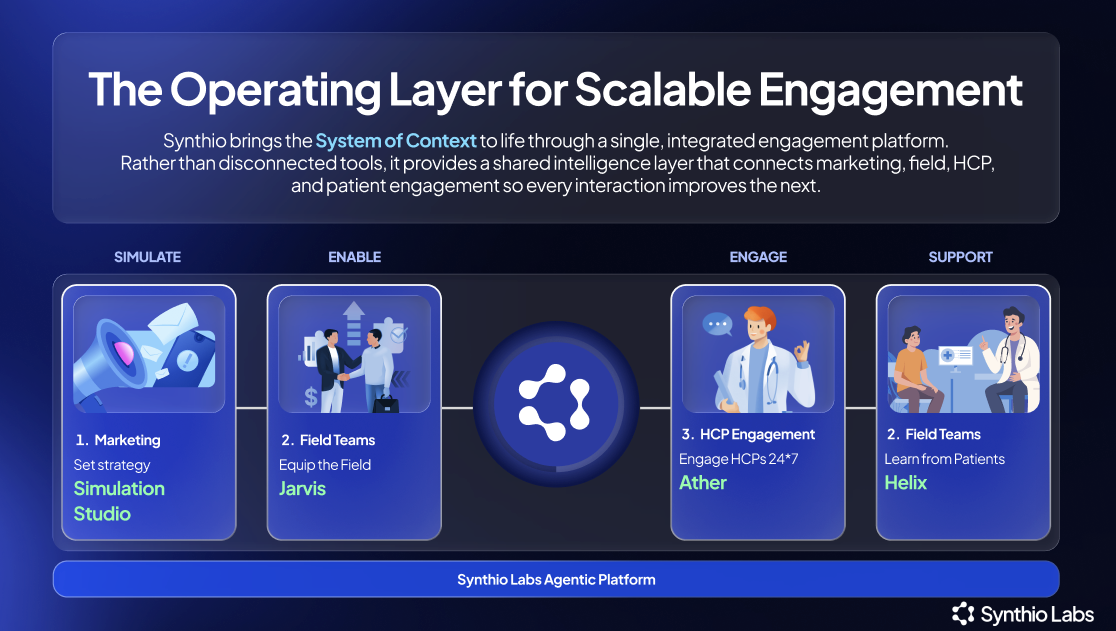
The best enterprise software hides complexity. Users get simple, intuitive experiences while sophisticated systems handle the hard work behind the scenes. They manage context, apply business rules, make intelligent decisions, and orchestrate across multiple systems.
The difference lies in everything surrounding the model: orchestration that knows which actions to take, data integration that keeps information current and accurate, structures that make your specific domain queryable, guardrails that enforce policies and compliance, monitoring that maintains quality, voice interfaces that work in the field, and deep domain expertise encoded into every layer.
These are what transform AI into something your organization can deploy at scale and rely on for business-critical decisions.
In regulated industries like life sciences, this matters even more. Your AI needs to understand not just language, but also your business. It needs to work reliably whether someone is typing at a desk or talking while driving to the next call. It needs to handle edge cases gracefully, escalate appropriately, and never compromise compliance.