




Fierce Pharma Week fireside chat with Genentech
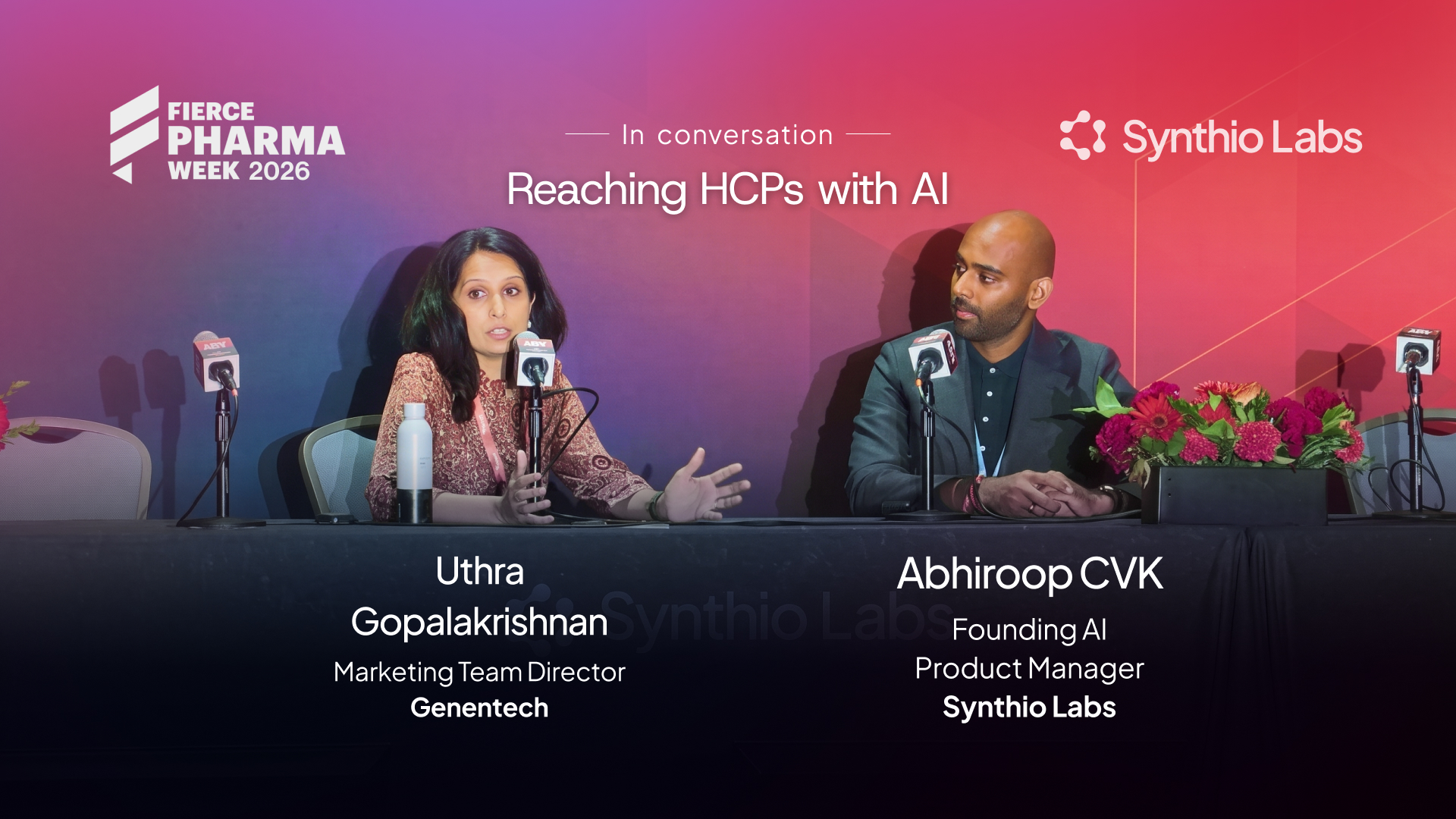

At Fierce Pharma Week 2026 in Philadelphia, Uthra Gopalakrishnan, marketing team director at Genentech, joined Abhi CVK of Synthio Labs for a fireside chat: "Beyond the Traditional Channels: Reaching HCPs with AI." Uthra has spent more than 12 years at Genentech, almost a decade of it in marketing, across every stage of a product's life cycle.
The conversation started from one test for any AI tool: beyond the talk of models, tokens, and prompt engineering, can it bring value? Here are the key takeaways from the conversation, on where AI pays off today, how it is changing the rep's role, and where human judgment still has the final say.
1. AI's biggest day-to-day gains: content and insights
From a marketing lens, Uthra sees AI paying off in two places:
- Content. First drafts of creative and copy come together faster. "I can visualize exactly what I want using AI, whether it's creative, whether it's copy," she said. That shortens the path for agencies and creative partners to a fully approved version.
- Insights. Dashboards full of dropdowns and checkboxes are giving way to simplified insights from real-world data, "available for us at our fingertips."
Both feed personalization: speaking to each customer in their language, about what they need at that moment.
2. HCPs expect one coordinated conversation
HCPs now get quick, generalized answers from AI tools on their own. When they turn to pharma, they want something more specific: help with patient journeys, access barriers, and how a therapy compares with competitors. That raises the bar for every field interaction.
The HCP is expecting behind-the-scenes coordination to happen. They don't want to hear the same information three different times.
The static leave-behind and single sales pitch worked five years ago. Today they fall short. At Genentech, the CRM pulls together what the MSL, access, and patient support teams have each logged for an HCP. AI then gets the rep ready for the next conversation, "focused on where the customer's head is at," so the field shows up "as one unified, prepared front."
The same logic runs across channels. HCPs and patients spend time on TikTok, Instagram, and YouTube, and "if we're not there, we're really not part of the conversation." Uthra's example from Genentech's multiple sclerosis franchise: listening to customers and patients surfaced pregnancy and breastfeeding as under-addressed moments in the patient journey. The brand partnered with medical teams to support patients through them.
3. Speed comes from starting small on approved content
AI makes it easy to turn one core visual aid into 50 variations. The risk: more assets can mean lost messages and less focus. Uthra sees the HQ–field tension as long-standing. A need surfaces in the field, teams wait for a trend, then create content and route it through review. "By the time we get something out, it's two months, three months maybe, and that need, that moment has actually passed." Genentech's approach is to start small, building on approved clinical claims:
- Images. Customers said materials would resonate more if the images reflected the patients they see. Swapping in AI-generated images representing different ethnicities was fast and "went a long way."
- Translation. AI speeds translation of approved materials into Spanish, Chinese, and other languages, with the approval workflow kept in place.
- Rep prep. Genentech is equipping its reps with an AI-powered voice system that surfaces insights before a call. For example: the customer visited the website and a reimbursement manager was in the office last week, so the next best action is a conversation about access services.
4. Human in the lead
Value to patients also depends on safety: knowing where AI's limits are, and where human judgment takes over. Two years ago, many expected AI to take over the marketer's role. Uthra has seen the opposite: "The marketer's role has actually gotten so much more critical because that human judgment and that human emotion component... it's only gotten more critical." AI takes on the busy work, and the marketer stays in the driver's seat. Her phrase for it: "not a human in the loop, but human in the lead." She named three areas where human judgment has to lead:
- Fairness and bias. "The model is only as good as the data we feed it," and historical data carries gaps in who was studied, who had access, and who was heard. People can spot those gaps and close them.
- Nuance and shifts. Cultural, policy, and regulatory shifts move faster than a model's data. "Humans absolutely need to come in and have the final say."
- Visionary risk-taking. "If you think about asking AI if it would recommend a phone without a physical keyboard, the answer would have been no. And look at where we are now."
Empathy, and even humor, stay human too. Uthra pointed to how Genentech has used humor to reach patients living with serious diseases.
5. Getting an organization AI-ready
The session closed with an unplanned question: what does it take to get an organization ready to adopt AI? Uthra's answer came in four parts:
- Pick one barrier and keep scope narrow. A focused MVP builds the credibility and trust that get people using a tool.
- Fit into existing workflows. Tools need to live in people's day-to-day work and understand natural language. Uthra now uses voice with her own AI assistant more often than typing.
- Start change management upfront. Make the "what's in it for me" clear for every team.
- Bring MLR, legal, and compliance in from day one. "MLR or PRC and legal and compliance, all of them need to have a seat at the table right from the outset. Do not bring them in later. They need to be co-creating the solution with you." The more complex the AI, the more this matters.
What we're taking forward
The conversation came back to three threads: find where AI is meaningfully used, keep content focused as it multiplies, and get new technology to the right customers safely. At Synthio Labs, we build AI for commercial pharma alongside commercial, medical, and compliance teams. Conversations like this one shape how we partner with them. Want to explore what AI could do for your brand, field, or medical teams? Reach out to us.