.svg)
.svg)
.svg)
.svg)
.svg)






.avif)


.svg)
.svg)
.svg)


Atlas: Better HCP Engagement Begins with a Better View

Every pharma team we’ve worked with has the same three or four systems open at once: A claims feed, an MDM record, a list vendor’s spreadsheet, and maybe a CRM note from a rep who talked to the doctor eighteen months ago. None of these systems talk to each other, and none were built to answer the question that matters most: who is this physician, really, and how should we engage them?
Claims data tells you what was prescribed. It doesn't tell you why. And the reference data layer that's supposed to fill in the "why" hasn't actually solved it either — it's still largely a directory. Fields get populated, refreshed on a schedule, and database gets sold on how many rows it contains. What you get is a name, a specialty, a license number. What you don't get is the person behind them.
That’s why we built Atlas: the AI-ready HCP 360
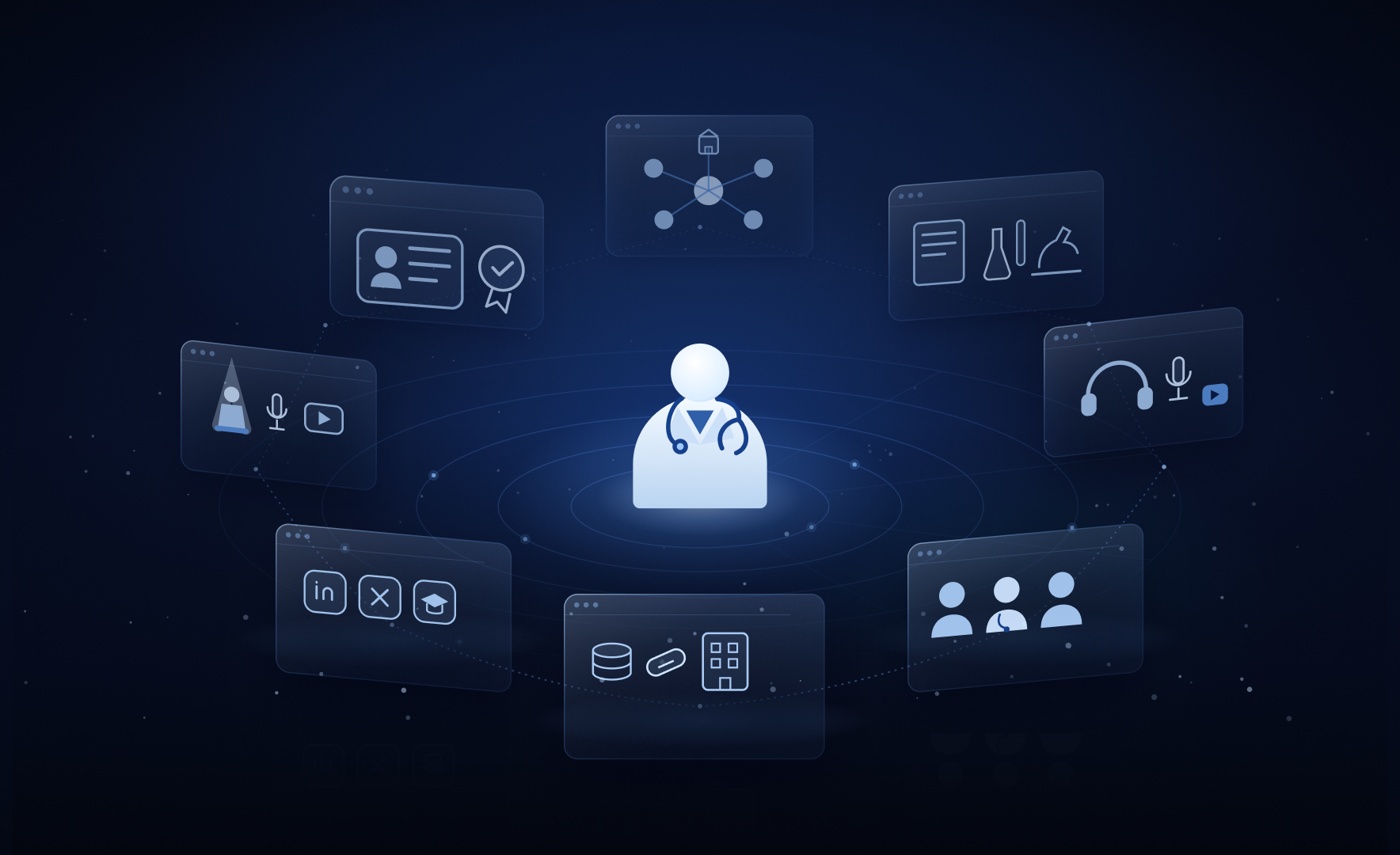
A comprehensive and current map of every physician resolved to a single verified identity and every fact behind it source-linked — over 9M physicians globally, across 20+ source families, and over 6B signals.
What a name and a license number can’t tell you
Take a physician sitting in the middle of your target list — not flagged as a priority, not on anyone’s must-call sheet. Look past the license and specialty, and a fuller picture emerges: they’re running a trial nobody tagged, they trained under your existing champion, they were on a panel recently alongside two physicians already on your radar, and they’ve spoken more openly about a competing treatment on a podcast than in any conversation with a rep.
Most of this information already exists somewhere. The standard approach is to license a slice of it and call that slice the picture. Atlas resolves the comprehensive picture to one identity.
Verification that challenges itself
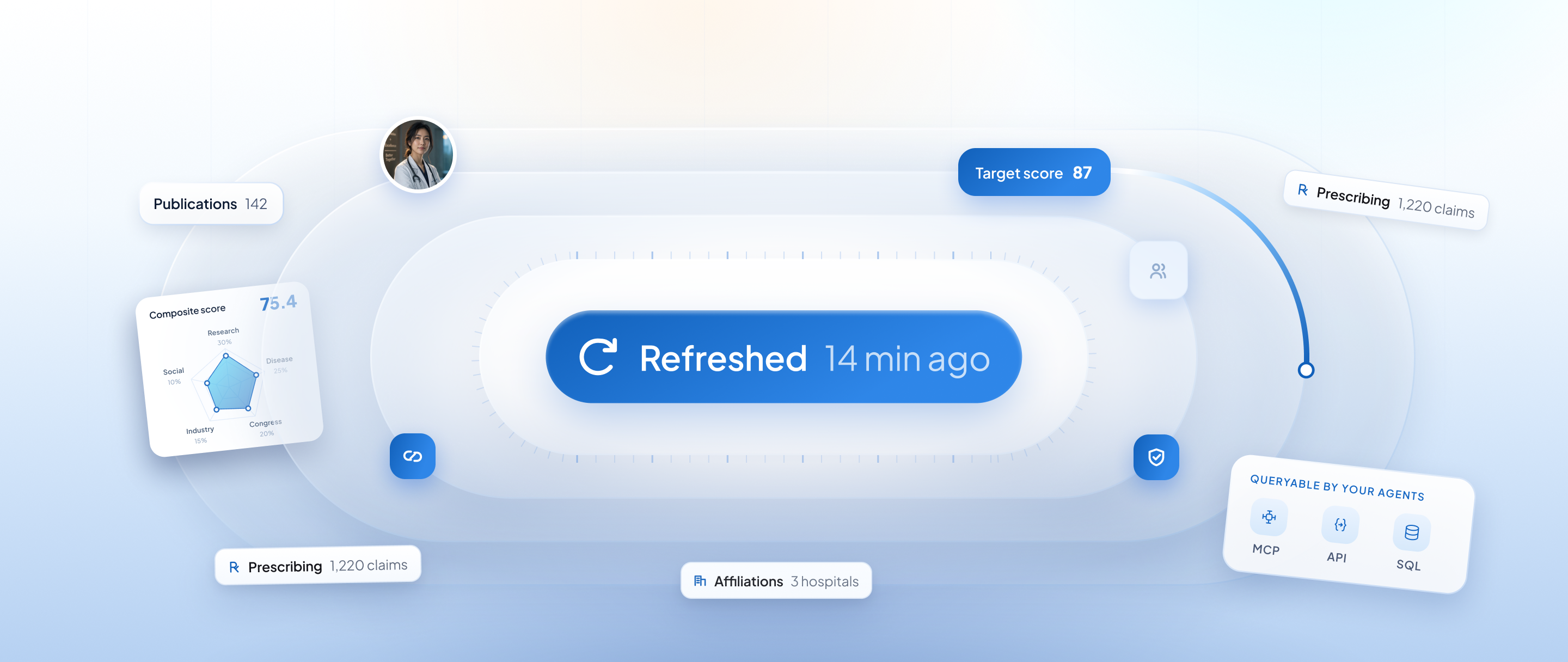
In Atlas, one system conducts the initial research. A second, independent system’s only job is to try to disprove it — rechecking sources, flagging anything it can’t confirm, and routing genuinely ambiguous cases to a human reviewer instead of guessing. Every field carries a confidence score, a source link, and a version history. Atlas monitors changes in the background all the time — when something about a physician changes, the record doesn’t just update, it gets rescored.
A record that tells you what to do with it
Raw fields answer “what do we know about this physician?” They don’t answer “what should we do about it.” Most data providers stop at the fields. Atlas turns the record into scores your team can act on — whom to prioritize, how strong the evidence behind that call is, and how the score changes for a specific brand or launch instead of one generic ranking for everyone.
The same goes for influence. Instead of simply counting co-authors or connections, Atlas shows you which physicians actually influence their peers — and lets you see the evidence behind that call rather than taking it on faith.
Built for the workflow you’re already in — and the one that’s coming
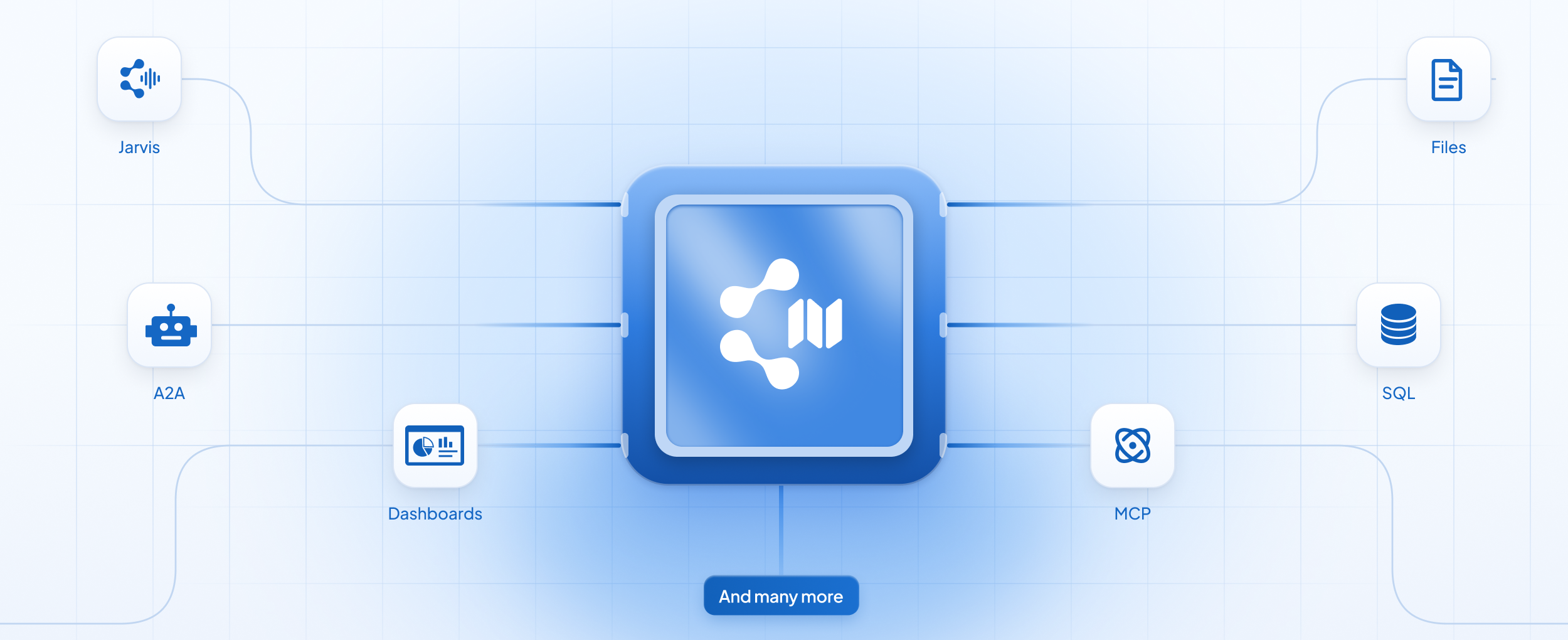
Atlas is native to Synthio’s Jarvis and it integrates with your dashboards, APIs, MCPs or flat files — wherever your stack requires. The record appears where your team already works, rather than in yet another portal.
It’s also built for the future: an AI agent or copilot can query the data directly and reason over it in real time, not just a person clicking through a dashboard. We built Atlas for that future — not as a bolt-on, but as part of the commercial and medical workflows taking shape now.
Meet Atlas
We built Atlas because we didn't trust the existing answer to "who is this physician?" enough to build commercial decisions on it. If your team is wrestling with the same question, reach out — we would be happy to show you how Atlas turns fragmented HCP data into an evidence-backed view your team can act on.