.svg)
.svg)
.svg)
.svg)
.svg)






.avif)


.svg)
.svg)
.svg)


Once I Got Voice-Pilled, I Could Not Go Back


I used to be a total disbeliever of voice before I joined Synthio Labs. Why would you ever use voice when you could barely get decent latency, or clarity in a public place? Let alone the struggle of trying to capture the professional nuances of language required for real work.
I used to get genuinely annoyed when friends sent me audio messages. Reading a text takes seconds; listening to a three-minute ramble was a chore. I had to manually filter out all the "ums" and "uhs" just to find the actual point of the conversation.
Ironically, I did like sending audio messages, though I did it sparingly, knowing my friends probably felt the same dread receiving them as I did. But I never put two and two together... until I joined the Synthio.
Voice as a foundation
At Synthio Labs, we’ve been busy building voice AI infrastructure for Pharma. Immersed in the tech, I finally took the opportunity to incorporate voice tools into my own daily workflows.
I did some research between typing and speaking speeds. For context, I was never slow at the keyboard. In fact, I’d like to believe I was pretty fast:
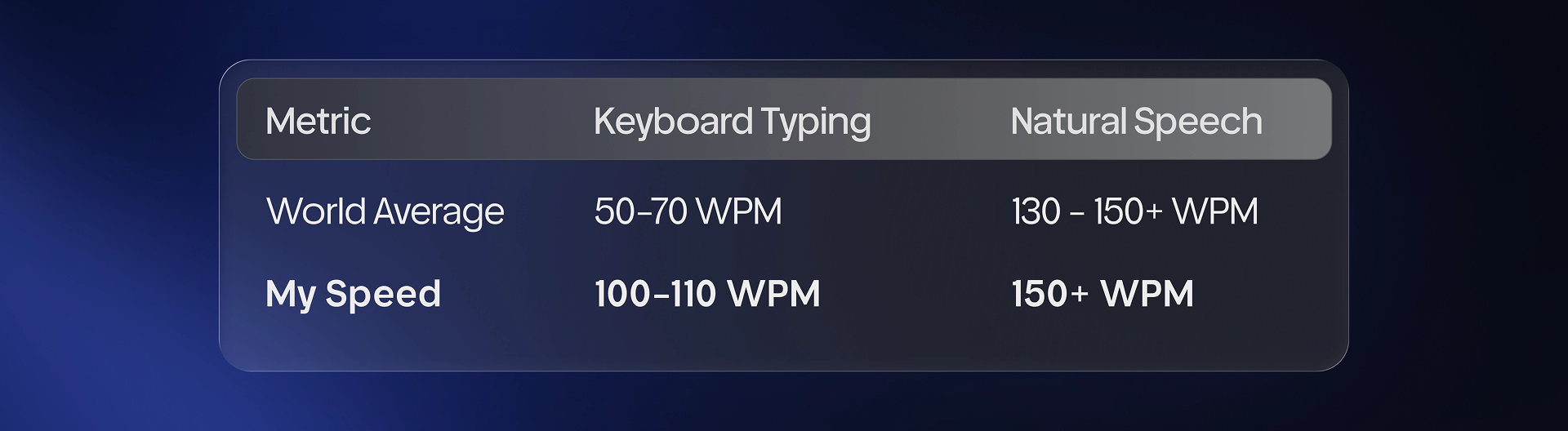
A Stanford study found that people input text roughly 3 times faster by voice than by typing on a keyboard — 161 words per minute speaking versus around 54 wpm typing. (Ruan et al., Stanford HCI, 2016).
But the real "voice-pill" moment wasn't just about speed. I awoke to how much the technology has evolved. Voice tools have become incredibly adept at understanding and filtering the "noise" of human speech.
- Seamless Filtering: Those "ums," "uhs," and awkward pauses? They're gone. Modern AI filters out the fluff and keeps the substance.
- Intent Mapping: These tools can now translate raw intent to the right audience, ensuring the tone remains professional and clear.
- Cognitive Load: The biggest benefit is being able to focus on the core message. When you aren't distracted by the syntax of written language or the physical act of typing, thoughts flow much more naturally. Sheepishly, I could argue your mouth is closer to your mind than your arms are, so naturally your thoughts will flow more seamlessly.
Take the Leap of Faith with me?
If you don't believe me, here’s the kicker: I actually wrote this entire blog post using just my voice. The friction I used to associate with "talking to my computer" has vanished, replaced by a flow state that I could never quite achieve even on my fancy mechanical keyboard.
I'm officially voice-pilled, and there is no going back to the old way.
Where do you think voice can fit into your workflows? And what do you think it would take for you to take that same leap of faith?