.svg)
.svg)
.svg)
.svg)
.svg)






.avif)


.svg)
.svg)
.svg)


Pharma Still Runs on Guesswork. That's About to Change.


Every major drug launch in the last decade has been preceded by months of market research. Focus groups. IDIs. KOL advisory boards. Patients recruited through CROs, flown in, compensated, moderated, transcribed, analyzed. The whole machinery.
And then the drug launches, and half the time, the insights were wrong anyway.
This isn't a small problem. The pharma industry spends north of $30 billion annually on market research. And the ROI on that spend is, to put it charitably, hard to measure. The dirty secret of pharma commercial strategy is that the research guiding billion-dollar launch decisions is slow, expensive, and riddled with bias. HCPs tell you what they think you want to hear. Patients struggle to articulate their treatment experience in a 60-minute interview. Moderators shape answers without realizing it.
And yet nobody talks about it. Because the system has worked well enough, for long enough, that questioning it feels like heresy.
The signal is already there if you're paying attention
A friend who runs a health-focused fund told me a few months ago: "The bottleneck in healthcare isn't treatment anymore. It's decision latency. The wrong insight, delivered too late, costs lives and billions."
"The Bottleneck in Healthcare isn't Treatment anymore. It's Decision Latency."
He wasn't talking about diagnostics. He was talking about the commercial and intelligence layer that wraps every drug that actually reaches patients.
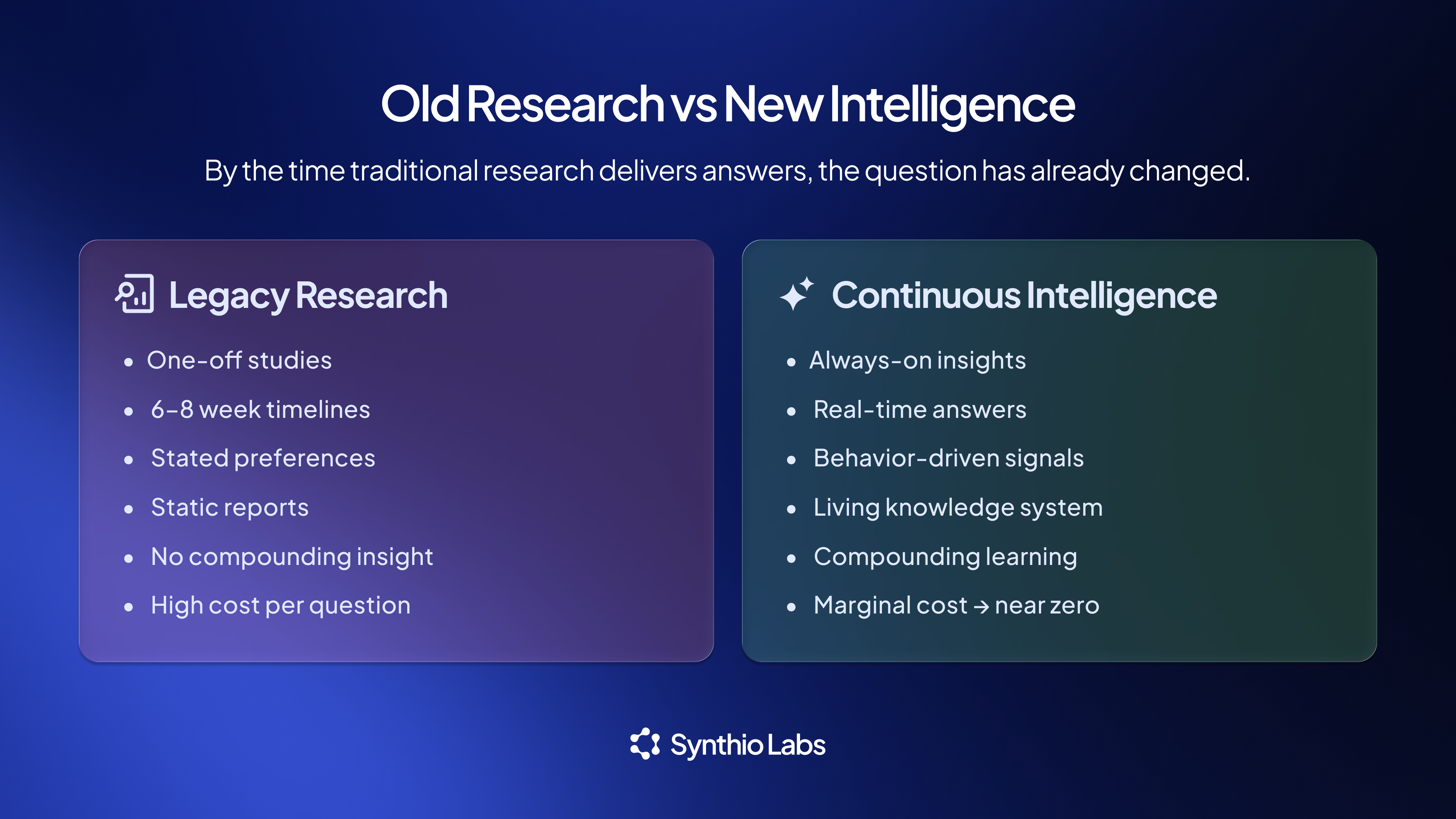
That framing stuck with me. A brand team wants to know how oncologists will react to a new dosing regimen. They submit the research request. Eight weeks later after recruiting, scheduling, moderating, transcribing, and analyzing, they get a report. The launch timeline has moved. The competitive landscape has shifted. The insight is stale before it's actionable.
The investors paying close attention to life sciences aren't just betting on AI for drug discovery. They're betting on something subtler: that the entire intelligence infrastructure around how drugs get developed, positioned, and launched is going to get rebuilt. "Speed-to-signal" is the phrase I keep hearing. How fast can you go from a hypothesis about physician behavior to a validated answer? Right now: weeks. It should be hours.
Why the traditional model is structurally broken
The CRO model was designed for a world where the only way to understand a physician was to put them in a room and ask. Recruit 12 oncologists. Fly them to Chicago. Get 90 minutes of responses shaped by social desirability, fatigue, and the particular moderator you happened to hire that day.
That world made sense when it was the only option. It doesn't make sense anymore.
The problems are structural, not executional. No amount of better recruiting or more skilled moderation fixes the fact that a single IDI captures a 60-minute slice of a physician's thinking, decontextualized from their actual clinical environment. It doesn't fix the fact that patients often can't retrospectively articulate treatment experiences with precision. It doesn't fix the 6-8 week lag between question and answer in a category where competitive dynamics shift monthly.
And it doesn't fix the cost. A mid-sized pharma company running 20-30 market research studies a year is spending $8-12M for insights that arrive late, reflect stated rather than revealed preferences, and can't be easily iterated on. That's a structural tax on good decision-making.
Three things that changed
What's new is that three things converged at once.
AI models got good enough to hold nuanced clinical context. For the first time, you can represent a physician's world with enough fidelity to actually stress-test a hypothesis against it. Treatment history, payer constraints, referral patterns, ingrained skepticisms about certain drug classes, the full clinical context that shapes a real prescribing decision. That kind of depth wasn't computationally tractable two years ago. Now it is.
The regulatory environment shifted. The FDA has been increasingly open about AI-generated evidence, particularly in rare disease contexts where recruiting real patients is nearly impossible. The compliance frameworks that pharma teams once used to block AI pilots are being rewritten.
And the buyers got desperate. Patent cliffs are real. Commercial windows are compressing. The cost of a bad launch decision is now existential at some companies. The appetite to defend slow, expensive processes purely out of institutional habit has collapsed.
What actually needs to change
The pharma industry needs to stop treating market research as a procurement exercise and start treating it as a continuous intelligence capability.
Right now, research is episodic. A study gets commissioned, runs, delivers a report, and gets filed. The next brand team starts from scratch. Insights don't compound. Physician understanding doesn't persist. Every question costs the same whether you've asked a version of it twenty times before or never.
The shift that's coming, and that the smartest commercial teams are already making, is toward persistent, reusable intelligence infrastructure. Understanding of HCP behavior that builds over time. Patient archetypes that get richer with every study that runs. Competitive signal that's always on, not delivered quarterly in a deck.
That's a fundamentally different operating model. It's closer to how a great product company thinks about user research, continuous, compounding, embedded in how decisions get made, than how pharma has historically thought about market research.
The thing nobody wants to say out loud
Traditional market research in pharma is a protected category. Big CROs have long-standing relationships. Procurement teams have preferred vendor lists. There's a compliance moat built over decades that has nothing to do with quality.
But the people who actually need the insights, brand teams, medical directors, commercial leads, are out of patience. They've been burned by research that took two months and told them nothing actionable. The institutional protections around the old model are eroding because the people those protections were supposed to serve have stopped believing in them.
The question isn't whether this changes. It will. The question is whether pharma companies lead that change or get dragged into it.
The window to build a real competitive advantage here is open right now. It won't be for long.