.svg)
.svg)
.svg)
.svg)
.svg)






.avif)


.svg)
.svg)
.svg)


SaaS Is Down 30%. Here’s How to Tell Who Survives AI


Everyone's eulogizing SaaS. But the real story isn't about software dying, it's about which companies have the courage to kill themselves before AI does it for them. A pharma lens on the oldest disruption playbook in the book.
Software stocks are down 30%. The discourse is predictably apocalyptic. LinkedIn is flooded with takes about "the end of SaaS." But if you've been paying attention, really paying attention, to what's happening in pharma's technology stack right now, you'd recognize this moment. We've been here before.
Cast your mind back roughly a decade. E-commerce had crossed a threshold. Amazon wasn't just growing, it was rewriting the physics of retail. And the question that separated the winners from the casualties wasn't "will this affect us?" Everyone knew the answer to that. The question was: which retail leaders were willing to look at their highest-margin, most beloved store formats and say, "this is already dead, let's be the ones who bury it first."
Most couldn't. The ones who could, a handful, became the retail survivors of that era. The rest are cautionary tales studied in business schools.
We are in that exact moment right now, in enterprise software. And if you're a CIO or AI leader in pharma, here is the simplest sniff test I can offer you.
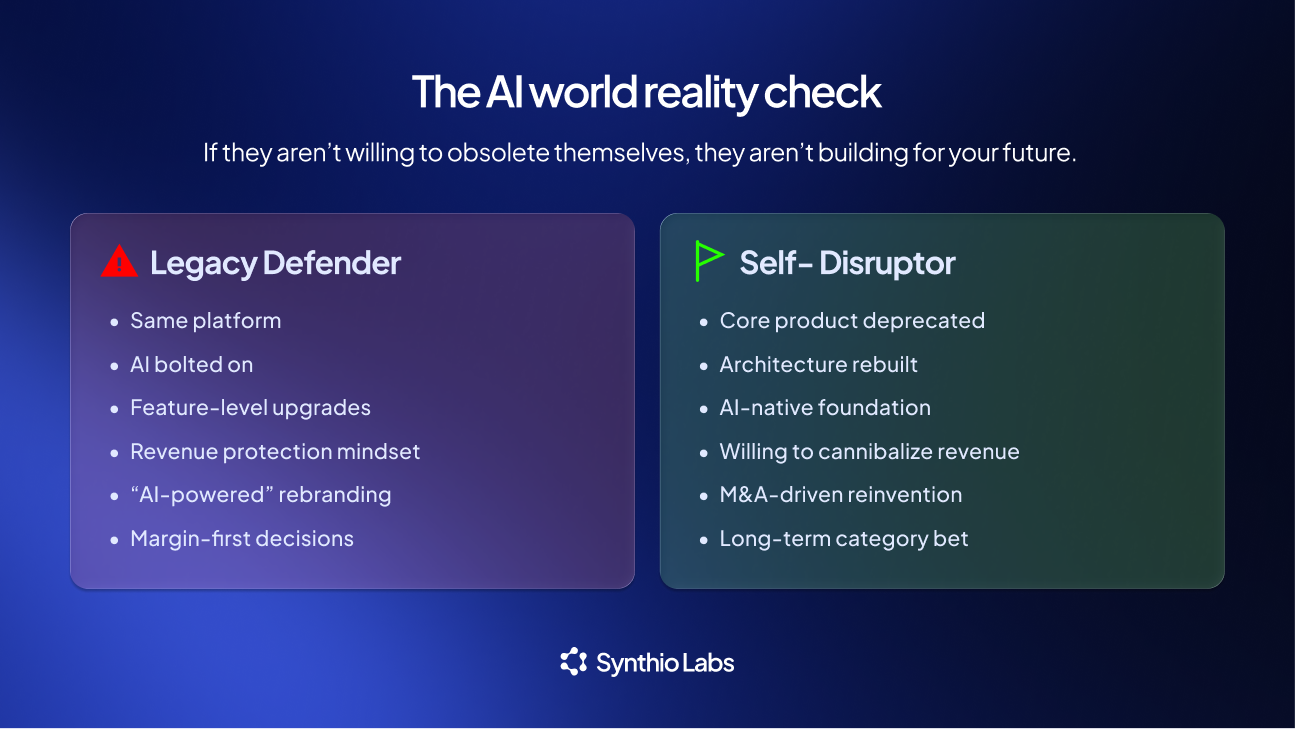
The CIO's Sniff Test: Two Types of Vendors
Red Flag
They're selling you the same platform you've had for a decade, while offering AI as a free feature bolted on top, a chatbot here, a "smart" dashboard there. They are too big to actually pivot. This is the Law of Inertia at institutional scale. They are not transforming; they are preserving margin while they figure out how to delay the inevitable.
Green Flag
They come to you and say: "Everything we sold you for the past decade is now deprecated, effectively zero value." Then they show you something genuinely different. Not the same wine in a new bottle, not a rebrand with AI in the name. A fundamentally new architecture. This kind of honesty almost always requires M&A, because the institutional resistance to self-disruption is too strong otherwise.
The Pharma Lens Makes This Even Clearer
In life sciences, the installed base of legacy software, Veeva, Salesforce, Tableau, Qlik, etc. is massive. These platforms became load-bearing walls in how commercial teams operate. Entire workflows, entire org structures, were built around their limitations. That stickiness was once a moat. Today it's a trap, for the vendors, not just their customers.
The pharma companies we work with at Synthio aren't asking whether AI will replace these platforms. That conversation is already over. The question is timing and transition. And the vendors who are showing up to those rooms and honestly admitting that their core product is being disrupted, that takes a different kind of leadership than we're used to seeing in enterprise software.
The ones who show up still pitching their existing product, with AI sprinkled on top as a feature? That's not a technology decision. That's a financial one. They're protecting this quarter's revenue. And in 12 months, that decision will look exactly as short-sighted as the department store CEOs who kept opening new locations in 2015.
Leadership Is the Variable
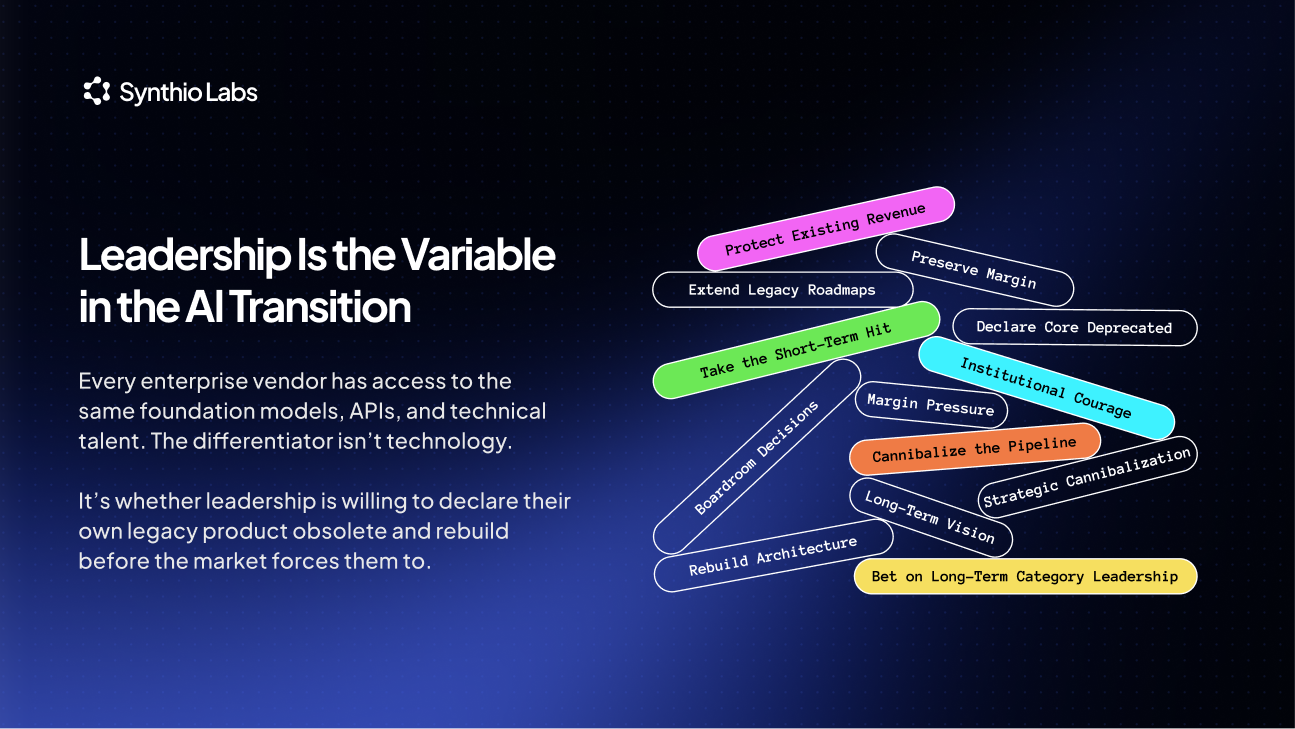
Here's the uncomfortable truth: this isn't really about technology. Every major software vendor has access to the same foundational models, the same API infrastructure, the same talent pool. The differentiating variable is whether the people at the top have the psychological and institutional capacity to declare their own legacy products dead.
That is an extraordinarily hard thing to do. It means walking into a board meeting and saying: the thing that generates 70% of our revenue today needs to be wound down. It means alienating your existing customer base in the short term. It means taking a margin hit that Wall Street will punish you for in the next earnings call. Almost no one does it voluntarily. The ones who do it tend to have either a founder's conviction or nothing left to lose.
In pharma, we call this "cannibalizing your own pipeline." The best drug companies do it all the time, they develop the drug that will make their own blockbuster obsolete, because if they don't, someone else will. It's painful. It's expensive. And it's the only strategy that actually works over a decade-long horizon.
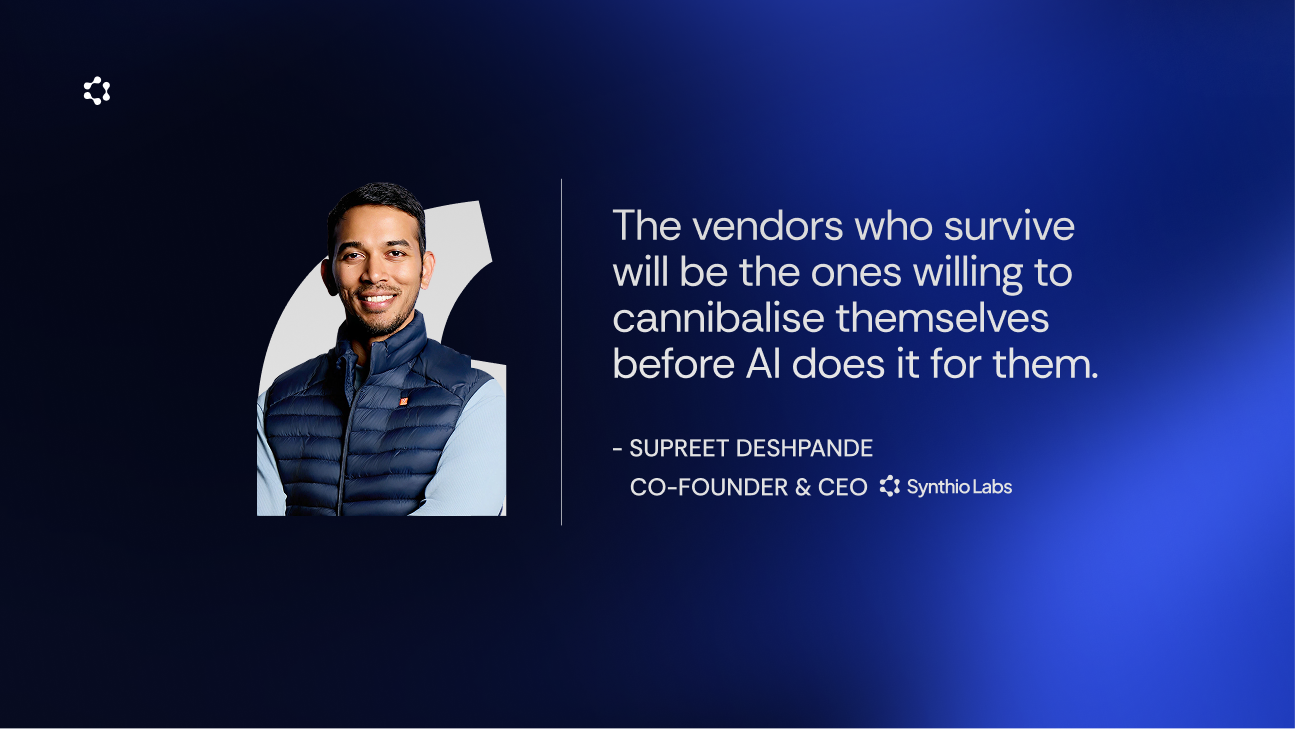
"Play it safe right now, and in less than 12 months, you'll be remembered as someone who simply lacked vision."
In retrospect, disruption always looks obvious. The patterns are always visible in hindsight. The e-commerce threat to brick and mortar wasn't subtle, it just required decision-makers to act against their immediate financial incentives. The AI threat to traditional SaaS is not subtle either. The only question is which leaders will act on what they already know.
To the CIOs and AI leaders reading this: your vendor relationships are about to become a referendum on your own judgment. The companies that are honest enough to deprecate themselves are the ones worth betting on. The ones still selling you yesterday's product with an AI badge, those are the companies that will be studying the retail apocalypse from the inside.
The universe has a way of rewarding those who act on what they already know to be true. The question was never whether AI would eat enterprise software. The question was always: who goes first?