.svg)
.svg)
.svg)
.svg)
.svg)





.avif)


.svg)
.svg)
.svg)


The Real Build-vs-Buy Question Is Which Companies Survive


A customer-support agent company sold for roughly a billion dollars last year, and almost no one outside the deal noticed that their customers had, overnight, become someone else's customers. NiCE announced its acquisition of Cognigy for about $955 million in July 2025 and began folding it into CXone. That is the sentence every technology leader should be reading twice, because it reframes the oldest question in enterprise software. For thirty years, build-versus-buy has been a decision about cost and control. In the agentic-AI market, that framing is obsolete — and clinging to it is actively dangerous, because it pushes leaders toward the wrong fix. It is now a bet on market structure — a wager on which companies are still standing when the consolidation wave recedes.
The market you are actually betting on
Consider the tape from the last eighteen months. Sierra AI, founded by Bret Taylor and Clay Bavor, raised roughly $350 million at a $10 billion valuation in late 2025, then about $950 million at $15.8 billion in May 2026 — more than tripling inside two quarters. Decagon closed a $250 million Series D in January 2026 that tripled its valuation to $4.5 billion against something like $35 million in ARR. Glean was valued near $7.2 billion in mid-2025, with ARR climbing from roughly $200 million to $300 million over the following year. Salesforce reported Agentforce driving AI ARR up about 120 percent year-over-year to roughly $1.1 billion. This is not how capital is allocated in a mature market — it is being concentrated, at speed, into a handful of names on the theory that a few will define the category and the rest will be absorbed or extinguished.
So the honest question isn't "should we build or buy." It's: how do I make a multi-year, hard-to-reverse platform bet while the market consolidates underneath me? Once you ask it that way, "build" and "buy" stop being the real choice at all. The real choice is who ends up holding the pen on your workflows, your data, and your decisioning logic - and that question has almost nothing to do with whether you own the platform or code.

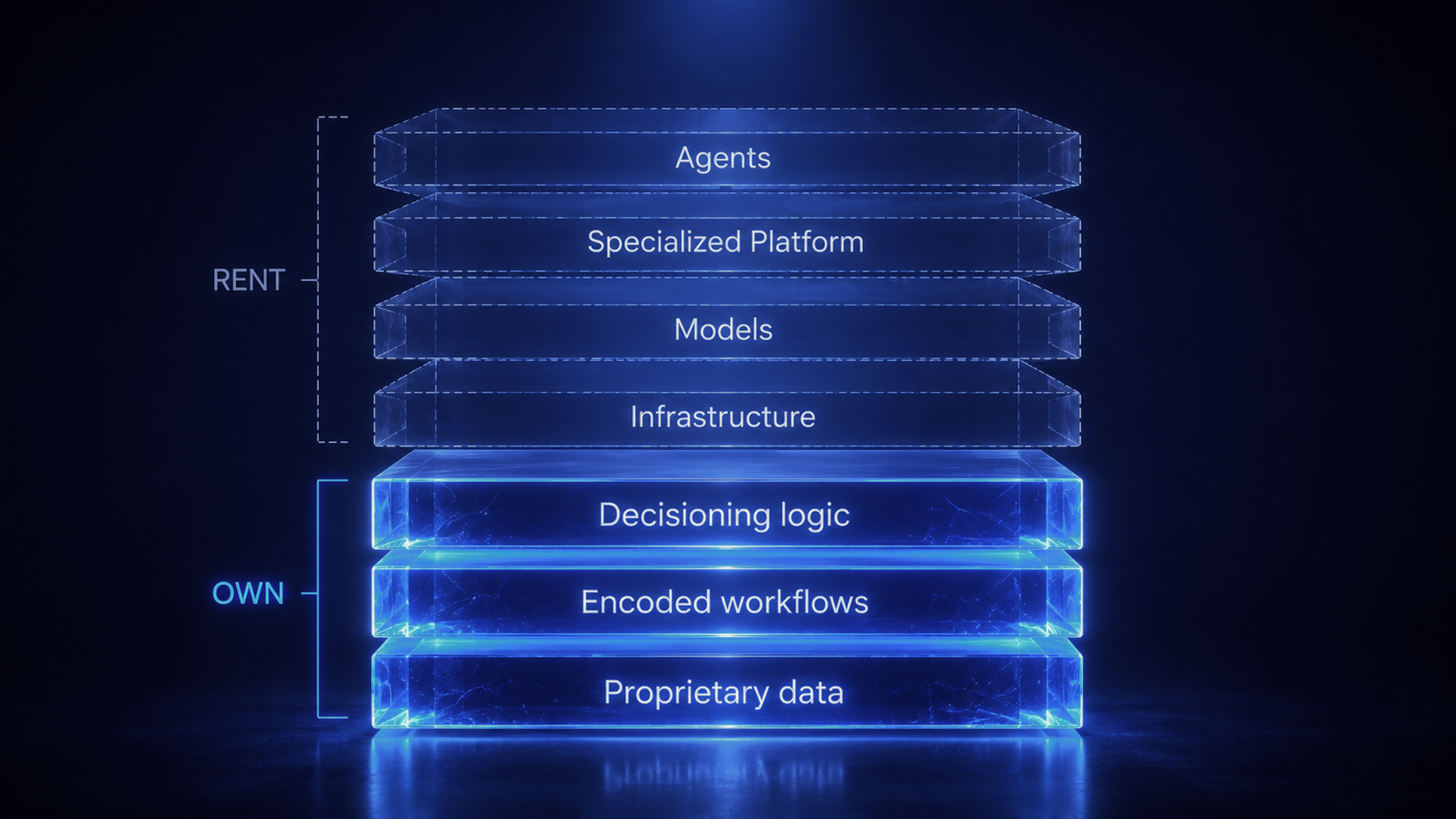
Here is the mental model I keep returning to: own the irreversible, rent the commoditizing.
Some things in your AI stack get more valuable the longer you hold them, and can't be repurchased once lost. Your proprietary data is the obvious one. The deeper asset is what sits on top of it - the workflows your organization has encoded, and the decisioning logic that turns raw capability into a specific, defensible outcome: which cases get escalated, what an agent is allowed to promise, what "resolved" means in your business. That logic compounds. Every edge case you teach it is a deposit you can't make twice. This is the irreversible layer, and it's the layer to own.
The companies getting this right treat the specialized platform to build their workflows on top of as the fastest, lowest-risk way to get to the irreversible layer at all, because a mature partner has already solved the commoditizing problems and can hand you a system where your workflows, your data, and your decisioning logic sit in a form you control.
What the winners will have been clear about
The reflex in a frothy market is to read velocity as safety: the company raising the most, growing ARR the fastest, must be the safe harbor. What's not realized is that the mega-rounds and tripling valuations are evidence of capital's conviction, not of your architecture's durability, and the two are easy to confuse when the headlines are loud. The enterprises that come out of this will be the ones that moved fastest to specialized partners for everything commoditizing.
They'll be the ones that were clearest, earliest, about which layer was theirs to own and which was only ever theirs to rent, and who built the seams to move when the ground shifted, regardless of who they were working with.