.svg)
.svg)
.svg)
.svg)
.svg)






.avif)


.svg)
.svg)
.svg)


We Built Context Graphs in Pharma Before It Was Cool


The last two weeks have been wild if you’re watching enterprise software. Jaya Gupta from Foundation Capital wrote about context graphs, and Sarah Wang from a16z laid out what may be her biggest 2026 idea: “Systems of Record are losing ground”, sparking a flood of takes on how AI will reshape how companies actually operate.
"AI is collapsing the distance between intent and execution. Models can now read, write, and reason directly across operational data"
We’ve been quietly nodding along. At Synthio Labs, this is exactly what we’ve been building for pharma and life sciences, driven by a problem that’s been obvious on the ground for a long time.
So here's our two cents from the pharma trenches. It is an industry that's complex enough to break most enterprise software patterns, given the compliance requirements, regulations, and the deep clinical expertise needed in go-to-market. But that's exactly what we do.
Pharma GTM 101: A Quick Primer For The Uninitiated
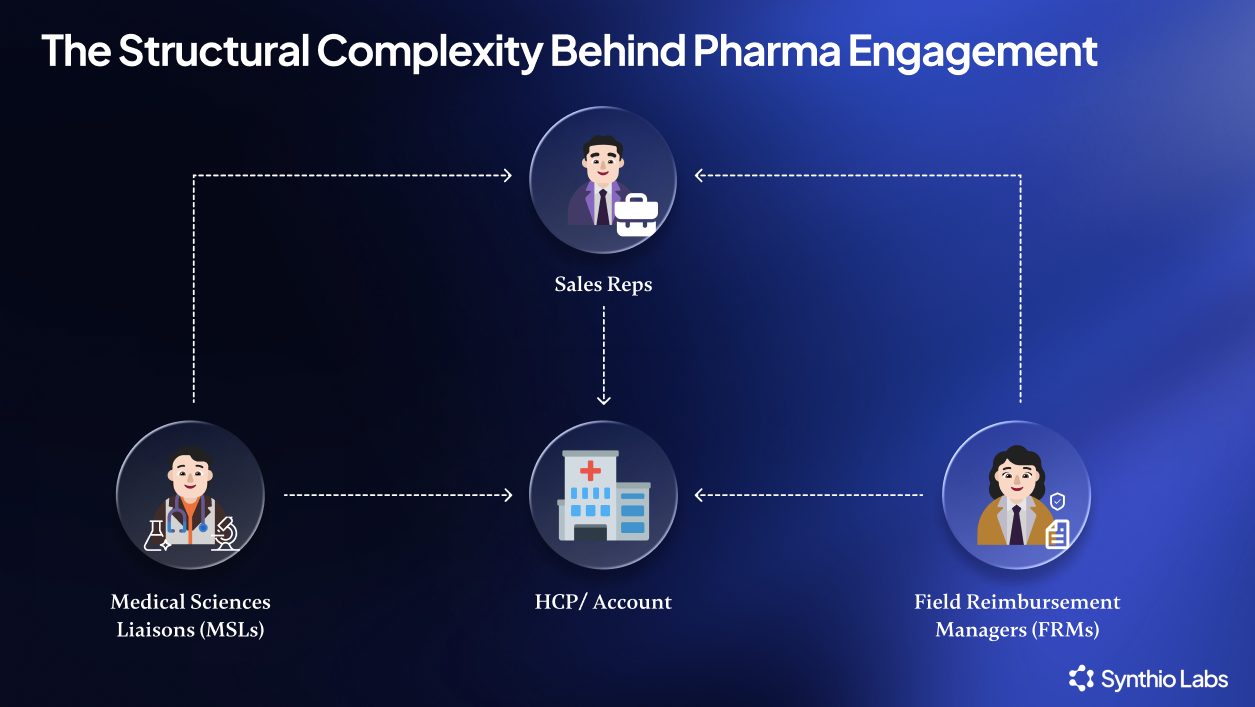
Before we dive in, let's level-set on how pharma GTM actually works.
Pharma doesn’t operate with a single GTM team. Multiple specialized roles engage the same accounts, often in parallel.
Sales reps work with Healthcare Providers (HCPs) to educate them on therapies and support appropriate prescribing.
Medical Science Liaisons (MSLs) are scientific experts who handle in-depth clinical discussions and medical questions. They focus on building scientific trust instead of sales.
Field Reimbursement Managers (FRMs) focus on access and affordability, helping navigate insurance coverage, prior authorizations, and patient support so that therapies reach patients.
Depending on the brand and market, there can be additional roles layered in as well.
These roles often engage the same HCP at the same account, but at different times and with different goals. Here’s the kicker though, everything they do must be compliant and traceable. They can't just wing it.
Oh, and this all happens across multiple channels, like in-person visits, digital platforms, patient support programs, and more.
Coordination becomes a massive problem. And that's before you add in the fact that pharma teams are trying to understand: Why is this account not prescribing? What's blocking adoption? What do we do next?
Now, back to our story.
Incumbents Can Just Add AI, Can’t They?
If you're not deep in the trenches of building AI agents, the default reaction to anything in this space is predictable: incumbents will add AI features, and the category goes away.
That logic holds if AI is just a feature. Things like summarization, auto-tagging, or faster documentation. But in life sciences, the core problem isn’t documentation but that of maintaining shared, auditable context across time, roles, brands, and channels.
When you try to solve that with surface-level outputs, you end up losing intelligent reasoning. You know what happened, but not why it happened or how that should inform what comes next.
That’s where a shared context layer becomes essential.
Interaction-Driven Systems Don’t Compound
Pharma commercial and medical teams run on interactions.
A Rep meets a HCP. An MSL follows up with scientific exchange. An FRM supports access and reimbursement. Another HCP asks a question through a digital channel. A patient needs support navigating their therapy journey.
Each of these interactions contains useful context, but most organizations store that context as isolated artifacts: a call note, a ticket, an email thread, a field in a CRM, or a message buried in a system that the rest of the team cannot see.
Leadership then asks the questions about these customers, such as about emerging unmet needs, stalling adoption, progress blockers, repeating objections. These answers barely exist, and they’re fragmented across people, channels, and time, so the full picture never quite comes together.
Shared Context Layer With Decision Trace
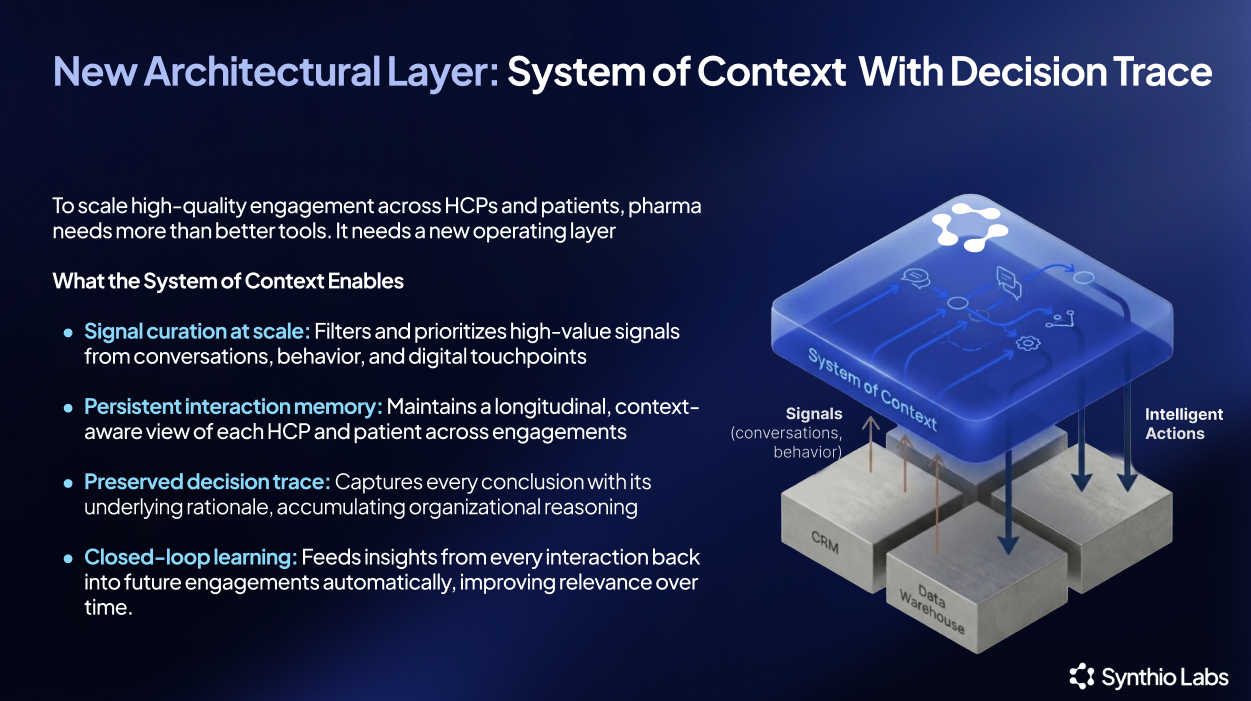
We propose an alternative to treating pharma engagements as disconnected events. Instead, to treat it as a living body of context that's compounds over time.
In practice, this means two things:
1. Provide the model with the exact relevant context for the next step
This reduces hallucination and keeps outputs aligned to policy and evidence
2. Preserve the decision trace
Capture system conclusions, why the conclusion was made, and which evidence influenced that conclusion
When this is done, field teams can begin accumulating organizational reasoning.
Imagine a specialty launch at a large community clinic. At this single account, a Rep, MSL, and FRM may engage the same HCP around different questions that unfold over time.
Without shared context, each interaction is isolated and the organization never compounds learning. Instead, with a shared context layer, barriers, decision drivers, stakeholders, and outcomes accumulate across roles into one evolving account understanding. Each interaction builds on the last and the team moves forward as a coordinated unit rather than three disconnected touch points.
Context Graphs Have To Be Built Bottom-Up
There's a lot of talk right now about building "orchestration layers" that coordinate across agents, or creating grand unified systems that manage everything from day one. But this doesn't work for context graphs.
In the last decade, the "everything app", e.g., WeChat, became legendary in China. One app for payments, chats, groceries, ride-sharing, government services, everything. But these everything apps only became possible after individual applications existed and proved themselves first.
The everything app was an emergent property of having robust, valuable individual applications that people actually used.
Context graphs are the same way. Shared context layer isn't something you design top-down and force upon specialized agents. It's something that emerges from agents doing real jobs really well.
Context sharing behaves like neural pathways. Connections strengthen where there is repeated, high-quality signaling, and fade where there isn’t. Without functional systems generating reliable signals, no meaningful network can form. Once agents are operating consistently, shared context becomes valuable.
Synthio Labs’ Approach To Shared Context
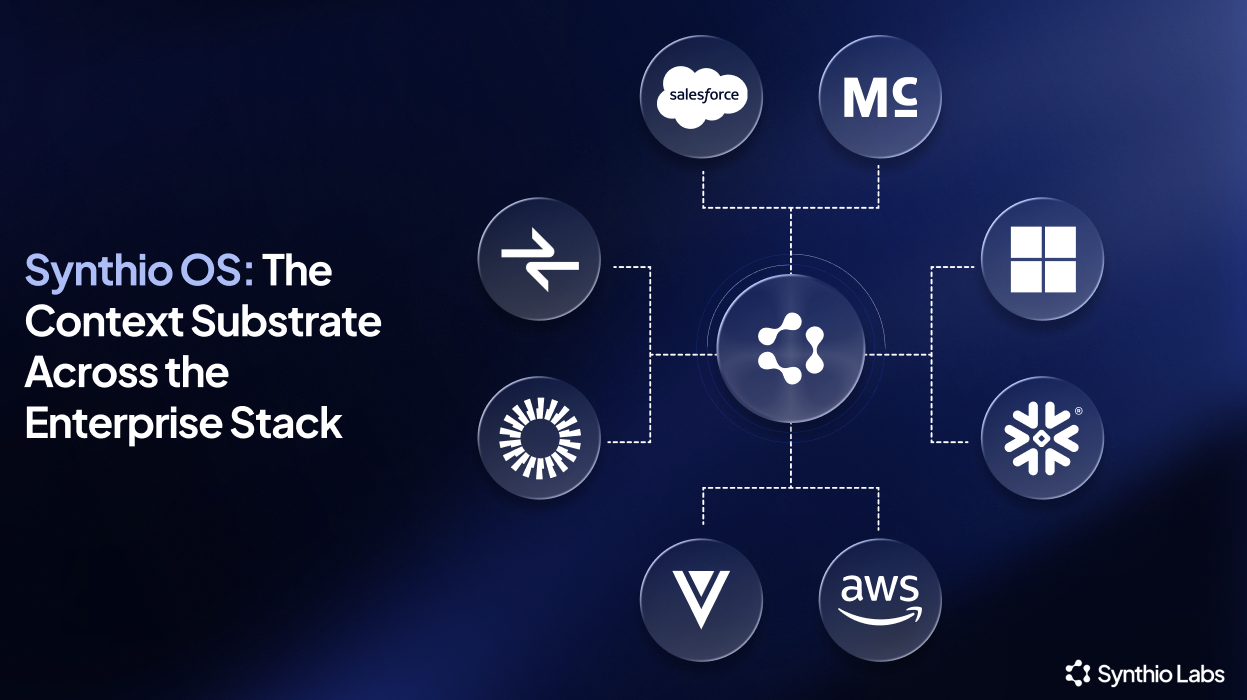
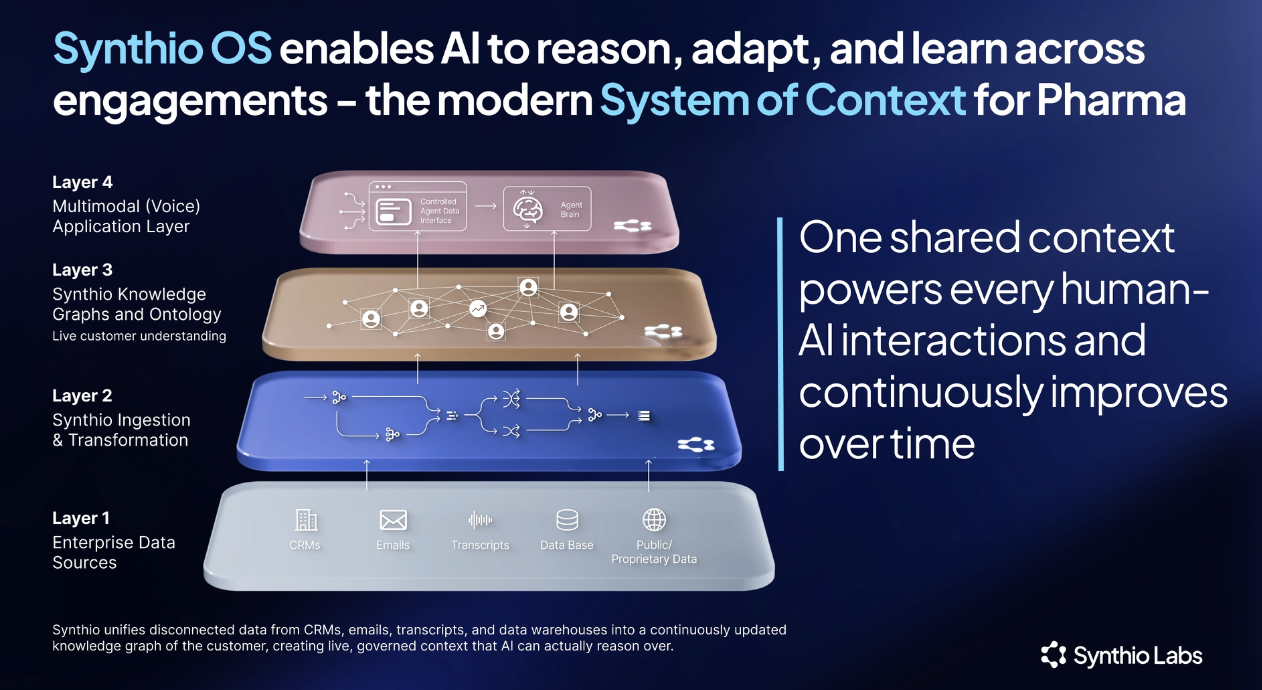
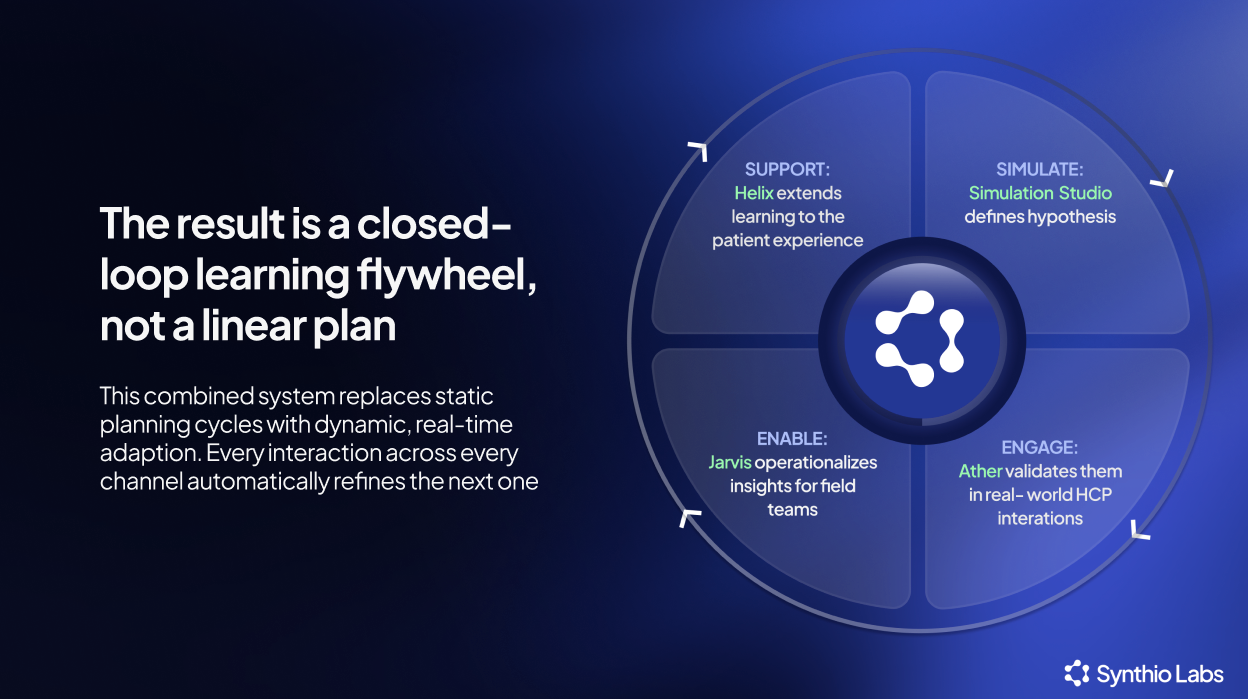
At Synthio Labs, we treat context as a first-class system, not a byproduct. Interactions are processed in real time by specialized agents that extract intent and outcomes; then we normalize them into a context graph. This persists across time, roles, brands, and channels, preserving reasoning and trace rather than just state.
That context layer is surfaced through three complementary products:
Jarvis supports reps, MSLs, and FRMs before and after every interaction. It prepares teams with relevant account context, then structures post-call outcomes into durable understanding across roles
Ather engages HCPs directly, capturing intent and needs at the source. These interactions become immediate signals for the field
Helix supports patients and surfaces friction across the journey. These feed back into the same context, enabling earlier intervention
Conclusion
When shared context exists across accounts and journeys, the learning compounds. Patterns that are nearly impossible to see manually emerge, such as rising unmet needs, recurring adoption blockers, interventions that shorten time to therapy.
This marks a shift from systems that merely record activity to those that inform action. In life sciences, this foundational shift in understanding customers is currently taking hold of the landscape.
From our vantage point in pharma, an industry that breaks most enterprise software assumptions, the future is systems that reason and compound learning. And that is what we are building, one piece at a time.